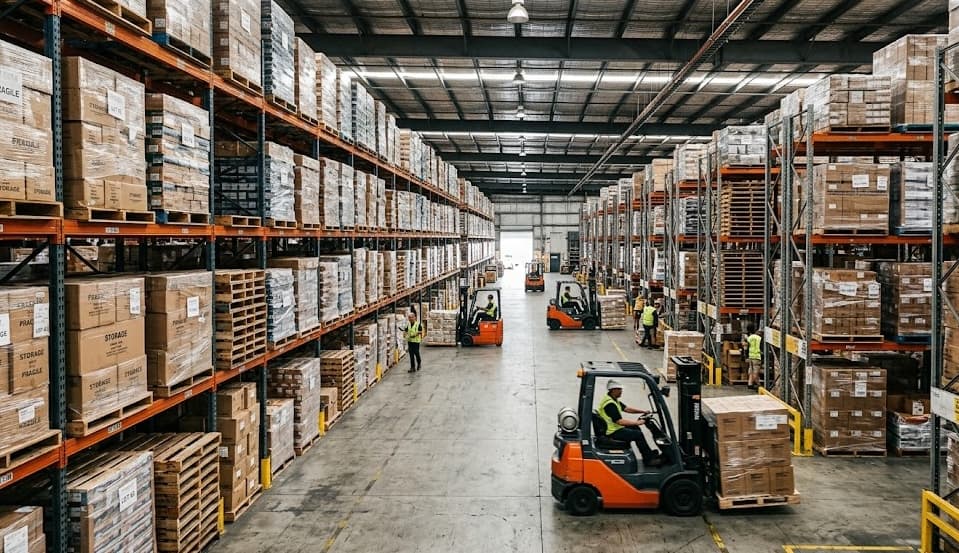
Wood Pallets — Used & Recycled
GMA standard and specialty sizes in every grade. Hardwood, softwood, and combo builds. Heat-treated options available for export compliance.
Get a Quote on Wood Pallets
Tell us your size, grade, and quantity requirements. We'll respond with competitive pricing within 24 hours.
The Industry Standard for Freight & Warehousing
Wood pallets remain the dominant platform for freight movement across North America, accounting for over 90% of all pallets in circulation. At Ace Pallet Service, wood pallets are our core product line. We maintain an inventory of tens of thousands of units across all standard sizes, grades, and construction types at our Warren, Michigan facility.
Every pallet that enters our yard is individually inspected and graded by experienced personnel. We check for structural integrity, dimensional accuracy, fastener condition, and surface quality. Pallets that meet our standards are sorted by size and grade, then stored in covered inventory areas to protect them from weather until they ship to your dock.
Whether you need a single stack of 48x40 GMA pallets for a one-time shipment or a recurring supply of thousands of units per month for a distribution center, Ace Pallet Service delivers consistent quality at competitive prices. We also offer heat treatment and ISPM-15 certification for pallets destined for international markets.
A Guide to Pallet Wood Species
The species of wood used in a pallet directly affects its strength, weight, durability, and cost. In the Michigan and Great Lakes region, the most common pallet lumber species are oak, pine, and poplar. Here is how they compare.
Oak (Red & White)
Oak is the premium hardwood for pallet construction. It is dense, hard, and extremely strong, with a Janka hardness rating of 1,220 to 1,360 lbf. Oak stringers and deck boards resist splitting from forklift tines, hold nails and screws exceptionally well, and tolerate repeated impact without cracking. White oak has natural rot resistance due to tyloses that block moisture penetration, making it especially durable in outdoor and humid environments.
Properties:
- • Density: 44 -- 47 lbs/cu ft
- • Janka hardness: 1,220 -- 1,360 lbf
- • Bending strength: excellent
- • Nail retention: superior
- • Rot resistance: moderate (white oak: high)
Best Uses:
Heavy loads, multi-trip pallets, automotive parts, racked storage, outdoor exposure. Ideal when the pallet will be reused many times and needs maximum durability.
Pine (Southern Yellow & White)
Pine is the most commonly used softwood in pallet construction nationwide. It is lighter than oak (which reduces shipping weight), easier to work with (which lowers production cost), and widely available from sustainable managed forests. Southern Yellow Pine is harder and stronger than White Pine, making it a popular choice for pallet stringers even when the deck boards are made from other species.
Properties:
- • Density: 28 -- 36 lbs/cu ft
- • Janka hardness: 380 -- 870 lbf
- • Bending strength: good
- • Nail retention: moderate
- • Rot resistance: low (requires dry storage)
Best Uses:
Light-to-medium loads, single-use or limited-trip applications, air freight (weight-sensitive), export pallets, combo builds (pine decks on hardwood stringers).
Poplar (Yellow Poplar / Tulipwood)
Poplar occupies the middle ground between hardwoods and softwoods. It is technically classified as a hardwood, but it is softer and lighter than oak, making it easier to machine and less expensive. Poplar grows fast and abundantly in Michigan and the surrounding Great Lakes states, which keeps supply consistent and prices competitive. Its straight grain and low tendency to warp make it reliable for pallet deck boards.
Properties:
- • Density: 29 -- 32 lbs/cu ft
- • Janka hardness: 540 lbf
- • Bending strength: moderate
- • Nail retention: moderate
- • Rot resistance: low to moderate
Best Uses:
Deck boards on combo pallets, medium-duty applications, food-contact pallets (poplar is odorless and non-staining), retail display pallets where a lighter color is desirable.
Stringer vs. Block Pallets: A Detailed Comparison
The two primary construction methods for wood pallets are stringer construction and block construction. Each has distinct advantages depending on your handling equipment, load characteristics, and budget. Understanding the difference helps you specify the right pallet for your operation.
Stringer Pallets
Stringer pallets use two or three long boards (stringers) running lengthwise to support the deck boards. They are the most common construction type in the United States, accounting for roughly 80% of all wood pallets produced. The stringers are typically 2x4 or 3x4 lumber, and the deck boards are nailed across the top of the stringers to create the load-bearing surface.
In their standard form, stringer pallets are two-way entry, meaning forklifts can only enter from the two ends where the stringers are exposed. However, most stringer pallets feature notches cut into the stringers (called "notched stringers") that allow partial four-way entry. The notches permit forklift tines to enter from the sides, though pallet jack entry is still limited to the stringer ends.
Key Specifications:
- ✓ Static load: 2,000 -- 2,500 lbs (standard), 3,000+ lbs (heavy-duty)
- ✓ Dynamic load: 1,000 -- 1,500 lbs
- ✓ Pallet weight: 30 -- 48 lbs
- ✓ Forklift entry: 2-way (4-way with notched stringers)
- ✓ Cost: lower than block construction
- ✓ Repair: straightforward -- stringers and boards easily replaced
Block Pallets
Block pallets use solid wood blocks (typically nine blocks arranged in a 3x3 grid) positioned between the top and bottom deck boards. Stringerboards connect the blocks and provide additional rigidity. This construction creates a true four-way entry pallet that both forklifts and pallet jacks can access from any side -- a significant operational advantage in high-throughput warehouses.
Block pallets are inherently stronger than stringer pallets of the same size because the blocks distribute load forces more evenly across the pallet structure. The nine-block pattern also provides superior support on racking beams, making block pallets the preferred choice for pallet racking systems where the pallet must span the beam gap without center support.
Key Specifications:
- ✓ Static load: 2,500 -- 2,800 lbs (standard), 4,000+ lbs (heavy-duty)
- ✓ Dynamic load: 1,500 -- 2,500 lbs
- ✓ Pallet weight: 45 -- 75 lbs
- ✓ Forklift entry: true 4-way (forklift and pallet jack)
- ✓ Cost: 15 -- 30% higher than stringer pallets
- ✓ Repair: blocks can be replaced individually
Weight Capacity by Size & Grade
Load capacity depends on the pallet size, construction type, wood species, and condition grade. The figures below represent typical static load ratings for standard stringer pallets in good condition. Block pallets and heavy-duty builds will exceed these numbers.
| Pallet Size | Grade A | Grade B | Grade C | Dynamic Load |
|---|---|---|---|---|
| 48 x 40" (GMA) | 2,500 lbs | 2,200 lbs | 1,800 lbs | 1,500 lbs |
| 42 x 42" | 2,500 lbs | 2,200 lbs | 1,800 lbs | 1,400 lbs |
| 48 x 48" | 3,000 lbs | 2,700 lbs | 2,200 lbs | 1,800 lbs |
| 36 x 36" | 1,800 lbs | 1,500 lbs | 1,200 lbs | 1,000 lbs |
| 48 x 42" | 2,500 lbs | 2,300 lbs | 1,800 lbs | 1,500 lbs |
| 48 x 45" | 2,800 lbs | 2,500 lbs | 2,000 lbs | 1,600 lbs |
Static load = weight the pallet supports on a flat surface. Dynamic load = weight the pallet supports while being moved by a forklift. Actual capacities depend on wood species, moisture content, and load distribution. Contact us for application-specific guidance.
Common Pallet Sizes
Beyond the ubiquitous 48x40, we maintain regular inventory in the sizes below. Non-standard and custom dimensions are also available — see our standard sizes guide for the full list.
The workhorse of the pallet industry. Used across retail, grocery, manufacturing, and distribution. Fits standard 53-foot trailers (double-stacked 20 per load). Available in all grades.
Load Capacity: 2,500 -- 2,800 lbs static
Popular in telecommunications, paint manufacturing, and chemical industries. Square format provides stability for cylindrical loads like drums and paint pails. Often used with four-way entry block construction.
Load Capacity: 2,500 lbs static
Heavy-duty square pallet designed for 55-gallon drums and large containers. Common in chemical, petroleum, and beverage industries. The wider footprint provides better stability for tall, heavy cylindrical loads.
Load Capacity: 3,000+ lbs static
Compact pallet ideal for retail floor displays, small warehouse spaces, and lightweight products. Often used in-store at big-box retailers for point-of-purchase displays. Easy to maneuver in tight spaces.
Load Capacity: 1,500 lbs static
Slightly wider than GMA standard, this size is favored by chemical and beverage manufacturers. The extra two inches of width provides better support for standard-sized drums and containers.
Load Capacity: 2,500 lbs static
Wider-format pallet common in automotive parts supply chains. The 45-inch depth accommodates auto parts trays and containers that don't fit standard 40-inch pallets. Frequently spec'd as block pallets.
Load Capacity: 2,800 lbs static
Heat Treatment & ISPM-15 Explained
ISPM-15 (International Standards for Phytosanitary Measures No. 15) is a global regulation that requires all solid wood packaging materials used in international trade to be treated to kill wood-boring insects and pathogens. Non-compliant wood packaging can be refused at customs, resulting in costly delays, fines, and re-shipment charges.
The Heat Treatment Process: Step by Step
Loading the Kiln
Pallets are stacked on carriages with spacer sticks between layers to ensure even airflow. The kiln is sealed and instrumented with core temperature probes placed in the thickest wood sections.
Heating to 56 deg C
The kiln raises the ambient temperature gradually. Per ISPM-15, the core temperature of the wood must reach a minimum of 56 degrees Celsius (132.8 degrees Fahrenheit). Our kilns are equipped with calibrated probes that confirm core temperature independently of the air temperature.
30-Minute Hold
Once the 56 degree C core threshold is reached, the temperature is held for a minimum of 30 continuous minutes. This duration is sufficient to eliminate all targeted organisms including the pine wood nematode, Asian longhorned beetle, and other invasive species.
Stamping & Certification
After treatment, each pallet receives the official IPPC (International Plant Protection Convention) stamp that includes our facility registration number, the country code (US), and the treatment code (HT). This stamp is internationally recognized at ports and customs worldwide.
Who Requires ISPM-15?
Virtually every country that is a signatory to the International Plant Protection Convention enforces ISPM-15. This includes the European Union, China, Australia, New Zealand, Canada, Mexico, Japan, South Korea, India, Brazil, and over 170 other nations. The United States also requires incoming wood packaging to be ISPM-15 compliant.
If you ship products internationally on wood pallets, crates, or dunnage, you need ISPM-15 compliance. The regulation applies to all solid wood packaging thicker than 6mm, including pallets, crates, skids, wood dunnage, and wood packing material.
Our On-Site Advantage
Many pallet suppliers outsource heat treatment to third-party facilities, adding days to your lead time and extra cost to your order. Ace Pallet Service operates its own heat treatment kiln on-site at our Warren, MI facility. This means we can treat pallets the same day you order them and have them ready for pickup or delivery within 24 to 48 hours.
Our kiln is regularly inspected and certified, and we maintain all required treatment records for auditing purposes. We can provide certificates of treatment on request for customers who need documentation for their supply chain records or customer audits.
Pallet Grades: A, B & C
We grade every pallet according to industry-standard criteria. Each grade represents a different balance of quality and cost. Read our detailed grading guide for the full specification.
Grade A -- Premium
Grade A pallets are in like-new condition. They may have been used once or twice but show minimal wear. All boards are intact with no cracks, stains, or major cosmetic defects. Stringers and blocks are structurally sound with no repairs visible. These pallets are suitable for retail display, export, and applications where appearance matters.
- ✓ No broken or missing boards
- ✓ No significant staining
- ✓ No protruding nails
- ✓ Full structural integrity
Grade B -- Standard
Grade B pallets show moderate wear but remain fully functional. They may have minor board repairs (one or two replaced boards), light staining, or cosmetic imperfections. Structurally, they meet the same load requirements as Grade A. This is our best-selling grade because it delivers the optimal balance between cost and performance for most warehouse and shipping applications.
- ✓ May have 1 -- 2 replaced boards
- ✓ Minor cosmetic wear accepted
- ✓ Full load-bearing capacity
- ✓ Best value for most operations
Grade C -- Economy
Grade C pallets have been through multiple use cycles and show significant wear. They may have several repaired boards, noticeable staining, and visible cosmetic defects. Despite their appearance, they still meet minimum structural standards for safe use with lighter loads. Ideal for one-way shipments, internal warehouse transfers, and applications where appearance is not a factor.
- ✓ Multiple board repairs common
- ✓ Visible wear and staining
- ✓ Meets minimum structural standards
- ✓ Lowest cost per pallet
Nail Patterns & Deck Board Configurations
Why Nail Patterns Matter
The number, type, and placement of nails in a pallet directly affect its structural integrity and service life. A standard GMA 48x40 pallet uses between 60 and 78 nails, depending on the configuration. Each deck board is fastened to each stringer with a minimum of two nails, and the lead board (the outermost board on each side) often receives three nails per stringer joint for added resistance to fork-tine leverage.
Screw-shank nails have a helical thread that increases withdrawal resistance by up to 40% compared to smooth-shank nails. They are the standard for pallets that will endure multiple trips and rough handling. Ring-shank nails have raised rings along the shaft that provide even greater holding power -- up to 2x the withdrawal resistance of smooth nails. We use ring-shank nails on heavy-duty custom pallets and any pallet where fastener pull-through is a concern.
Improperly placed or missing nails are one of the most common causes of pallet failure. During our inspection process, we check every fastener point and re-nail any joints that are loose, missing nails, or showing signs of pull-through.
Deck Board Configurations
The arrangement and spacing of deck boards determines the pallet's load surface characteristics. There are three primary configurations:
Full Deck (No Gaps)
All deck boards are placed edge-to-edge with no gaps between them. This creates a solid, continuous surface ideal for small items, bags, and anything that could fall through gaps. Full-deck pallets are heavier and more expensive due to the additional lumber, but they prevent product loss and provide maximum support for irregularly shaped loads.
Partial Deck (Standard Gaps)
Deck boards are evenly spaced with 1 to 3 inch gaps between them. This is the standard configuration for most pallets and provides the best balance of material cost, weight, and load support. The gaps allow air circulation, which is important for produce and food products that need airflow during refrigerated transport.
Reversible (Double-Deck)
Reversible pallets have deck boards on both the top and bottom surfaces. Either side can face up, which doubles the pallet's effective life since wear is distributed between two surfaces. Reversible pallets are common in heavy-duty applications and are often specified as block pallets for racking compatibility.
Load Testing & Performance Standards
Pallet performance is not guesswork. Industry standards published by ASTM International, the National Wooden Pallet and Container Association (NWPCA), and ISO define exactly how pallets should be tested and rated. Understanding these standards helps you compare suppliers and ensure you are getting pallets that meet your operational requirements.
Static Load Test
Measures the maximum weight a pallet can support when resting on a flat, solid surface with the load evenly distributed. This is the most commonly cited capacity and represents the maximum weight you can stack on the pallet during warehousing. Testing follows ASTM D1185 protocol.
Dynamic Load Test
Measures the maximum weight a pallet can support while being lifted and moved by a forklift. Dynamic loads are always lower than static loads because the movement introduces additional stress, vibration, and potential for impact. Typically 40 to 60 percent of the static rating.
Racking Load Test
Measures the maximum weight a pallet can support when placed on racking beams with no center support (the pallet spans the beam gap). This is the most demanding load condition and applies only to pallets used in pallet racking systems. Testing follows ASTM D1185 with span specifications.
Fork Tine Bending Test
Evaluates the pallet's resistance to deflection when lifted by forklift tines at standard entry points. Excessive deflection under load indicates insufficient stringer or deck board thickness and increases the risk of pallet collapse during handling.
Compression Test
Measures the vertical compression strength when loaded pallets are stacked on top of each other. This test determines how many pallets can be safely stacked in a warehouse without the bottom pallet collapsing. Critical for floor-stacking operations.
Drop Test
Simulates rough handling by dropping a loaded pallet from a specified height onto a hard surface. This test reveals how well the pallet absorbs impact without structural failure and is especially important for pallets used in freight that will be unloaded by gravity conveyors or dock plates.
Moisture Content, Storage & Stacking Guidelines
Why Moisture Content Matters
The moisture content (MC) of pallet wood has a significant impact on its strength, weight, and susceptibility to mold. Green (freshly cut) lumber can have moisture content exceeding 30%, while properly dried or heat-treated pallet wood is typically in the 12 to 19% MC range. The National Wooden Pallet and Container Association recommends a maximum of 19% MC for pallets entering commerce.
High moisture content makes wood heavier (increasing your freight cost), weaker (reducing load capacity), and vulnerable to mold growth (which can contaminate products and trigger claim rejections). Our heat treatment process inherently reduces moisture content to safe levels, and we store finished pallets under cover to prevent re-absorption from rain and ambient humidity.
For customers in food, pharmaceutical, or export applications where moisture and mold are critical concerns, we can provide moisture-tested pallets with documented MC levels below your threshold requirement.
Stacking & Storage Best Practices
- 01Store on level ground. Uneven surfaces cause pallets to bear load unevenly, accelerating wear on one side and creating instability in stacked configurations.
- 02Keep pallets dry. Store indoors or under tarps whenever possible. Prolonged moisture exposure causes swelling, warping, and mold growth that degrades pallet quality.
- 03Limit stack height. Empty pallets should not be stacked more than 15 units high for stringer pallets and 20 units high for block pallets. Higher stacks increase the risk of collapse and worker injury.
- 04Rotate your inventory. Use first-in-first-out (FIFO) rotation for your pallet stock to prevent older pallets from sitting unused and degrading over time.
- 05Inspect before use. A quick visual check before loading catches cracked boards, loose nails, and other damage that could cause product damage or safety incidents during transit.
A Brief History of the Wood Pallet
The modern wood pallet as we know it emerged during World War II, when the U.S. military needed a standardized platform to move massive quantities of supplies to theaters of war around the globe. Before pallets, goods were loaded into cargo holds one box at a time -- a labor-intensive process called "break-bulk" shipping. The introduction of the forklift and the standard pallet transformed logistics, reducing loading times by up to 80%.
The Grocery Manufacturers Association (GMA, now the Consumer Brands Association) standardized the 48x40-inch pallet in the 1960s, creating a common platform that could be shared across manufacturers, distributors, and retailers. This standardization enabled the intermodal transportation revolution -- goods could move seamlessly from factory floor to truck to warehouse to retail shelf without being unpacked and repacked at each transfer point.
Today, an estimated 2 billion wood pallets are in circulation in the United States alone, with approximately 500 million new pallets manufactured each year. The pallet industry consumes roughly 40% of all hardwood lumber produced in the United States, making pallet manufacturing the single largest consumer of hardwood lumber in the country.
Despite the rise of plastic, metal, and composite alternatives, wood pallets continue to dominate because of their unbeatable combination of low cost, repairability, and recyclability. The pallet recycling industry -- of which Ace Pallet Service is proud to be a part -- processes hundreds of millions of pallets annually, extending the useful life of the lumber and keeping it out of landfills. It is a circular economy that has been functioning effectively for decades, long before the term became fashionable.
Hardwood, Softwood & Combo Builds
Hardwood Pallets
Oak, maple, and birch provide the highest load capacities, greatest resistance to damage, and longest service life. Hardwood decks resist puncture from heavy or sharp-edged loads and hold fasteners better than softwoods. They are heavier and more expensive, but the per-trip cost is often lower due to their durability.
Best for: heavy loads, multi-trip use, racking, automotive.
Softwood Pallets
Pine, spruce, and fir are lighter and less expensive. They work well for lighter loads and single-use or limited-trip applications. Softwood is easier to work with, which means faster production and lower cost. The trade-off is reduced durability -- softwood boards are more susceptible to splitting and surface damage.
Best for: light loads, one-way shipments, air freight, export.
Combo Pallets
Combo pallets use hardwood stringers or blocks for structural strength with softwood deck boards for cost savings. This hybrid approach is popular because it delivers much of the durability benefit of hardwood at a price point closer to softwood. Approximately 40% of the used pallets in our inventory are combo builds.
Best for: general warehousing, distribution, balanced cost/performance.
Competitive Pricing & Bulk Discounts
Wood pallet pricing varies based on size, grade, material, treatment, and quantity. Because lumber markets fluctuate, we provide custom quotes rather than publishing fixed prices. This ensures you always get the most competitive rate based on current market conditions.
That said, here are the general pricing tiers to help you budget. Contact us for an exact quote tailored to your specific requirements.
Small Orders
1 -- 99 pallets
Standard per-unit pricing. Ideal for one-time shipments or testing a new supplier.
Mid-Volume
100 -- 499 pallets
Volume discount applies. The most common order range for regular warehouse operations.
Bulk / Contract
500+ pallets
Best per-unit pricing. Contract rates available for recurring monthly or quarterly orders.
Ace Pallet Service · 7236 Murthum Ave, Warren, MI 48092