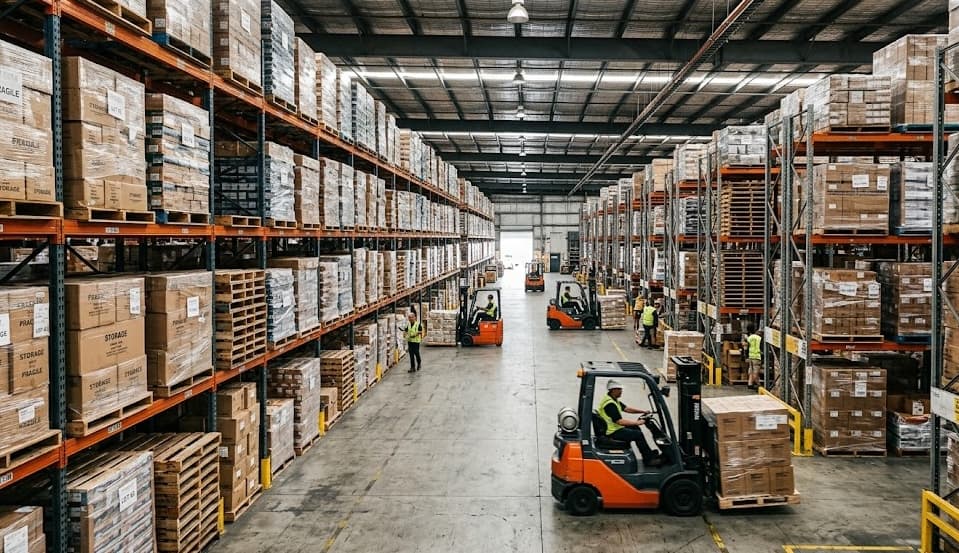
Pallet Jack and Forklift Compatibility: Choosing the Right Pallet for Your Equipment
Not every pallet works with every piece of handling equipment. Learn how pallet entry configurations, deck spacing, and fork dimensions affect compatibility with your forklifts and pallet jacks.
Dave Morrison
Ace Pallet Service · Published August 18, 2025
Understanding Pallet Entry Types
Pallets are classified by the number of sides from which forks can enter. Two-way entry pallets allow fork access from only two opposite sides. Four-way entry pallets can be accessed from all four sides. This distinction has major implications for warehouse layout and material handling efficiency.
Stringer pallets are typically two-way entry, though notched stringers can provide partial four-way access for forklift tines. Block pallets are true four-way entry because their block-and-board construction creates openings on all sides.
Choosing the wrong entry type can create serious operational bottlenecks. If your warehouse aisles require side access to pallets but you are using two-way entry pallets, operators must reposition loads before they can be picked up, wasting time and increasing damage risk.
Pallet Jack Compatibility Considerations
Standard pallet jacks have fork widths of approximately 27 inches measured outside to outside, with individual tines typically 6.5 to 7 inches wide. The opening between pallet deckboards or between the bottom deck and stringers must be tall enough and wide enough to accommodate these forks.
Most standard pallets provide a fork opening height of 3.5 to 4 inches, which is sufficient for manual and powered pallet jacks. However, some lightweight or economy pallets have reduced clearances that can prevent jack entry or cause wheels to drag.
Pallet jacks require smooth fork entry to operate safely. Pallets with warped or sagging bottom deckboards, broken stringers, or protruding nails can jam pallet jack forks, creating dangerous situations for operators.
Forklift Fork Dimensions and Pallet Design
Forklift forks come in various lengths, widths, and thicknesses. Standard forks for a typical warehouse forklift are 42 inches long, 4 inches wide, and 1.5 inches thick. However, forks range from 36 to 96 inches in length depending on the application.
The pallet must have sufficient opening height to accommodate the fork thickness plus clearance for lifting. Standard pallets provide adequate clearance for most forklift forks, but specialized equipment may require specific pallet configurations.
Fork length should match pallet depth. Forks that are too short leave the pallet unsupported at the back, creating a tipping hazard. Forks that are too long extend past the pallet and can damage products or racking on the opposite side.
Automated System Compatibility
Automated material handling systems including conveyor systems, automated guided vehicles, and robotic palletizers have the tightest pallet compatibility requirements. These systems are designed for specific dimensions and tolerances, and they cannot adapt to variations the way a human operator can.
Conveyors typically require consistent bottom deck board configuration, overall height, and weight distribution. Pallets with missing bottom boards, excessive deflection, or dimensional variations outside tolerance will jam conveyor systems.
If your operation uses or plans to use automated handling equipment, coordinate pallet specifications directly with your equipment supplier. Ace Pallet Service can manufacture pallets to the tight tolerances that automated systems demand.
Matching Pallets to Your Operation
The best way to ensure pallet compatibility is to document your equipment specifications and share them with your pallet supplier. List every type of handling equipment in your facility, including fork dimensions, weight capacities, and any specialized attachments.
Consider the full journey of your pallets, not just your own facility. If pallets will be handled at customer locations or retail stores, they must be compatible with equipment at those destinations as well.
Ace Pallet Service can review your equipment specifications and recommend pallet designs that ensure compatibility throughout your supply chain. Whether you need standard GMA pallets or custom configurations, we build to specifications that work with your equipment.
Tags:
Questions About This Topic?
Our team is ready to help you apply these insights to your business. Get a free consultation and quote.